
Compress images without losing quality
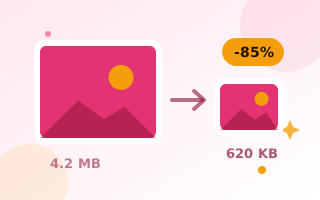
Large images are the most common reason websites load slowly. Slow pages rank lower in Google, and visitors leave them sooner. This image compressor reduces the file size of JPG, PNG and WebP images, often by 50–80%, while keeping them looking the same to the human eye. You can compress many images at once and download them individually or all together.
How to compress an image
- Drag and drop your images onto the box, or click to choose files.
- Set the quality. 70–80% is the best balance for most photos.
- Leave the output format on Auto to get the smallest file automatically, or choose the original format, JPG or WebP.
- Optionally set a maximum width, such as 1920 px, to shrink very large photos.
- Download each image or click Download all.
Why compress images?
- Faster websites. Smaller images improve Core Web Vitals such as Largest Contentful Paint (LCP).
- Better SEO. Page speed is part of Google’s page experience signals.
- Less storage and bandwidth on your hosting account.
- Easier sharing. Stay under email and form upload limits.
Private by design
Many online compressors upload your photos to their servers. This one does not. It uses your browser’s built-in image engine, so your files never leave your computer or phone. That also makes it fast, because there is no waiting for uploads and downloads.
Tips for the smallest files
Photos compress best as JPG or WebP. Graphics with flat colours or transparency are usually best as PNG or WebP. If an image is much larger than the space it fills on your page, resize it first with the image resizer, or change its format with the image converter.
Compress to an exact file size
Many forms and portals say “maximum 50 KB” or “under 100 KB”. Type that number into Target file size and the compressor finds the best quality that fits, scaling the image down slightly only if it must. Quick links: 20 KB, 50 KB, 100 KB and 200 KB.
Lossy vs. lossless compression
- Lossy (JPG, WebP): removes detail the eye barely notices. Huge savings, adjustable with the quality slider.
- Lossless (PNG): keeps every pixel. Smaller savings, best for graphics with text and sharp edges.
Auto mode tries your original format and WebP and keeps the smaller result, so you get the best saving without needing to know the details.
Recommended image sizes for websites
| Image | Width | Target size |
|---|---|---|
| Full-width hero banner | 1920 px | under 250 KB |
| Blog featured image | 1200 px | under 150 KB |
| In-content image | 800–1200 px | under 100 KB |
| Product photo | 1000–1600 px | under 150 KB |
| Thumbnail | 300–600 px | under 40 KB |
Image compression and SEO
Images are usually the heaviest part of a web page. Oversized images slow down Largest Contentful Paint (LCP), a Core Web Vital that Google uses in its page experience signals. Compressing images, serving WebP and sizing them correctly is one of the quickest ways to improve a PageSpeed Insights score. Remember to add descriptive file names and alt text too, so your images can rank in Google Images.
Compressing photos on your phone
This compressor works in mobile browsers. Open this page on your phone, tap the upload box, choose photos from your gallery and download the smaller versions. It is ideal for sending photos over WhatsApp or email without hitting size limits.
Privacy
Compression happens on your own device using your browser’s built-in image engine. Your photos are never uploaded, stored or seen by anyone else. Re-encoding also removes EXIF metadata such as GPS location.
Frequently asked questions
Are my images uploaded to a server?
No. Compression happens inside your browser, so your images never leave your device.
What quality setting should I use?
70–80% gives a large size reduction with almost no visible difference for photos. Use 85–90% for images with fine text or detail.
Why did my PNG not get much smaller?
PNG is a lossless format. For a much smaller file, set the output format to WebP, which supports transparency too.
How many images can I compress at once?
There is no fixed limit. Dozens of images work well. Very large batches depend on your device memory.
Is there a file size limit?
No hard limit. Very large photos (over 50 MB) may be slow on older phones.