
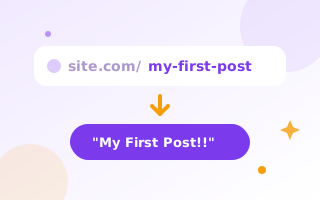
What is a URL slug?
The slug is the readable part of a web address that identifies a page, such as free-seo-tools in example.com/free-seo-tools/. A good slug tells both people and search engines what the page is about before they click.
How to create an SEO-friendly slug
- Type or paste your page or post title.
- Choose hyphens (recommended by Google) or underscores.
- Optionally remove stop words and numbers, and set a maximum length.
- Copy the slug. For many titles at once, paste them into bulk mode, one per line.
What the generator does
- Converts everything to lowercase.
- Replaces accented letters (é → e, ü → u) and turns “&” into “and”.
- Removes punctuation and symbols such as ! ? : and quotes.
- Joins words with a single separator and trims to your chosen length without cutting a word in half.
Slug best practices for SEO
Keep slugs short: three to five words is ideal. Include your main keyword, leave out dates if the content will be updated, and avoid changing a slug after a page is published. If you must change one, add a 301 redirect from the old address. Check how the final URL looks in search results with our SERP preview tool.
Good vs. bad slugs
| Bad | Good |
|---|---|
| /index.php?p=4821 | /compress-image-to-100kb/ |
| /10-Best-Tips-For-2026!!!/ | /seo-tips/ |
| /the-ultimate-complete-guide-to-how-you-can-improve-your-website-seo-in-2026/ | /website-seo-guide/ |
| /blog_post_about_images/ | /image-optimization-guide/ |
Why slugs matter for SEO
- Google shows the URL path in search results, so a readable slug helps people trust and click your result.
- Keywords in the URL are a small relevance signal, and they become the anchor text when people paste your bare link.
- Short slugs are easier to share, remember and type.
What the generator handles for you
- Accents and special letters: “Café Crème” becomes
cafe-creme. - Symbols: “&” becomes “and”; punctuation such as ! ? : , and quotes is removed.
- Stop words (optional): “How to Start a Blog in 2026” becomes
how-start-blog-2026. - Numbers (optional): remove years so the URL stays evergreen when you update the article.
- Length limit: trims at a word boundary, never mid-word.
Slugs on WordPress, Shopify and Wix
WordPress creates a slug from your title automatically, but it keeps every word. Edit it in the URL or Permalink field of the editor. Shopify and Wix have a “URL handle” or “URL slug” field in each page’s SEO settings. Paste the slug from this tool there. Remember to add a 301 redirect if you change the slug of a page that is already published.
Frequently asked questions
Should I use hyphens or underscores in URLs?
Use hyphens. Google treats hyphens as word separators, but may read words joined by underscores as a single word.
Should I remove stop words from slugs?
Usually yes, to keep URLs short, as long as the slug still reads naturally.
How long should a URL slug be?
Aim for three to five words, or under about 60 characters. Shorter slugs are easier to read, share and remember.
Can I create many slugs at once?
Yes. Paste one title per line into the bulk box and all slugs are created together.