What Is a Good ACoS? Break-even ACoS With 3 Worked Examples
“What's a good ACoS?” has no single answer, because the same ACoS can make money on one product and lose it on another. The number that decides it is your break-even ACoS: your profit margin before ads. We ran three example products through our FBA calculator and ACoS calculator to show how it works with real arithmetic.
The four numbers in one minute
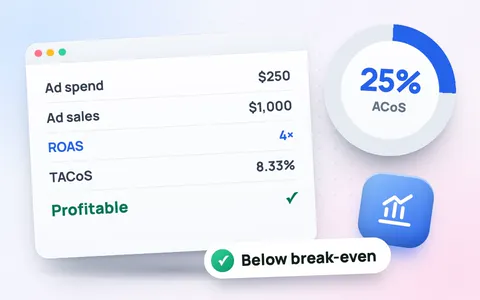
- ACoS = ad spend ÷ ad sales × 100. Lower is better.
- ROAS = ad sales ÷ ad spend (the same idea the other way round: 30% ACoS = 3.33× ROAS).
- TACoS = ad spend ÷ total sales (ads and organic). It shows how dependent the product is on ads.
- Break-even ACoS = profit margin before ads. Below it, ads make money; above it, they lose money.
Step 1: margin before ads (FBA calculator)
These are example products: the costs and FBA fees are assumptions for illustration, with Amazon's usual 15% referral fee. Use your own figures from Seller Central.
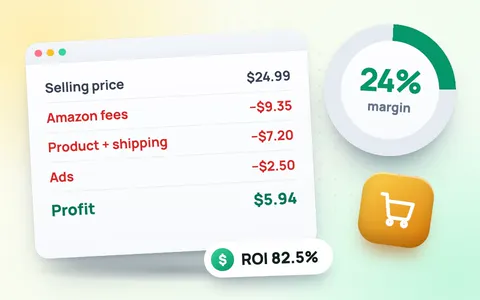
| Product | Price | Product + shipping in | FBA fee | Profit / unit | Margin |
|---|---|---|---|---|---|
| A: kitchen gadget | $19.99 | $5.00 | $4.50 | $6.79 | 33.97% |
| B: water bottle | $29.99 | $9.30 | $6.20 | $9.04 | 30.14% |
| C: phone case | $14.99 | $2.20 | $3.90 | $6.14 | 40.96% |
Storage ($0.10–0.35) and packaging/returns ($0.40–0.60) per unit are included.
Step 2: the campaigns (ACoS calculator)
| Product | Ad spend | Ad sales | ACoS | Break-even | Result after ad cost |
|---|---|---|---|---|---|
| A | $300 | $1,000 | 30% | 33.97% | +$39.70 |
| B | $450 | $1,500 | 30% | 30.14% | +$2.10 |
| C | $250 | $500 | 50% | 40.96% | −$45.20 |
What the examples show
- The same 30% ACoS gave very different results. Product A made $39.70 on $1,000 of ad sales; product B made just $2.10 on $1,500, because its margin (30.14%) is barely above the ACoS.
- A “bad” ACoS isn't always the problem. Product C has the best margin (40.96%) but loses $45.20 because ACoS is 50%. The calculator's target: bring ACoS under 40.96%, i.e. ROAS above 2.44×.
- TACoS gives context. A and B both had 10% TACoS, so two thirds of their sales came without ads. That organic profit is what makes a near-break-even campaign like B still worth running for ranking.
- The cheap product needs the most efficient ads. C's average order is only $15.15, so every wasted click hurts more.
How to bring ACoS under break-even
- Cut search terms that spend without orders and add them as negatives.
- Raise conversion rate before raising bids: title, main image, price and reviews. C converted at 6.6% vs A's 10%.
- Improve the margin (cheaper inbound freight, smaller packaging tier) to lift the break-even itself.
- Get keywords right per marketplace: our marketplace keyword test found only 30% of top phrases shared between the US and other stores.
Frequently asked questions
What is a good ACoS on Amazon?
Any ACoS below your break-even ACoS (your margin before ads) is profitable. With a 34% margin, 30% is good; with a 30% margin, 30% only just breaks even.
How do I calculate break-even ACoS?
Take your profit per unit before ads and divide it by the selling price. In our example A, $6.79 ÷ $19.99 = 33.97%.
What is the difference between ACoS and TACoS?
ACoS divides ad spend by ad sales only. TACoS divides it by all sales, so it falls when organic sales grow.
Is a high ACoS ever acceptable?
For a short launch or ranking push, yes, as long as you plan it and watch TACoS. Long term, keep ACoS under break-even.